
 |
 |
 |
 |
 |
 |
 |
 |
 |


| "Grass-fed beef has more beta-carotene, vitamin E and Omega-3 fatty acids than beef produced using conventional cattle-feeding strategies," according to a research review conducted by University of California Cooperative Extension and California State University, Chico. Read more... |


There are many health benefits of eating grass-fed
beef.
Perhaps you have heard of the important studies
that have been made which cite the health
benefits of Omega-3 oils? A diet with a high
proportion of Omega-3 oils is better for your heart,
brain and liver functions. When you hear people
talking about all the great health benefits for
eating salmon, they’re talking about Omega-3 oils.
Iowa State University conducted a study in 2001
and found that there are more Omega-3 oils in
grass-fed beef than there are in fish! Combine
that with the fact that you’ll have 700% greater
chance of getting an E. coli infection from eating
feedlot beef, the benefits of choosing grass-fed
beef become resoundingly clear.
Cows were born to eat grass.You cannot find
anything more natural. By eating grass-fed
beef, it’s not just your health that improves,
the ecosystem’s health improves.
Management Intensive Grazing (MIG), also known
as "grass farming," "rotational pasture
management," and "prescribed grazing" is an
environmentally and economically viable system of
forage-based animal production.
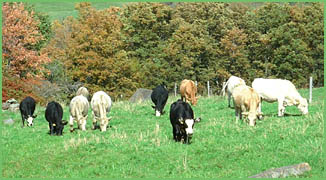
Vermont's landscape and topography are well
suited to pasture production. North Hollow Farm’s
livestock are rotated from pasture to pasture and
self-harvest most of their own feed. Our staff
closely monitors the health of both the animals
and the pasture plants to ensure that optimal feed
conditions are met.
beef.
Perhaps you have heard of the important studies
that have been made which cite the health
benefits of Omega-3 oils? A diet with a high
proportion of Omega-3 oils is better for your heart,
brain and liver functions. When you hear people
talking about all the great health benefits for
eating salmon, they’re talking about Omega-3 oils.
Iowa State University conducted a study in 2001
and found that there are more Omega-3 oils in
grass-fed beef than there are in fish! Combine
that with the fact that you’ll have 700% greater
chance of getting an E. coli infection from eating
feedlot beef, the benefits of choosing grass-fed
beef become resoundingly clear.
Cows were born to eat grass.You cannot find
anything more natural. By eating grass-fed
beef, it’s not just your health that improves,
the ecosystem’s health improves.
Management Intensive Grazing (MIG), also known
as "grass farming," "rotational pasture
management," and "prescribed grazing" is an
environmentally and economically viable system of
forage-based animal production.
Vermont's landscape and topography are well
suited to pasture production. North Hollow Farm’s
livestock are rotated from pasture to pasture and
self-harvest most of their own feed. Our staff
closely monitors the health of both the animals
and the pasture plants to ensure that optimal feed
conditions are met.
| All images and content copyright 2005. North Hollow Farm. |